When sourcing bags from a factory in China or elsewhere, you will encounter two acronyms constantly: OEM and ODM. They describe fundamentally different relationships between your brand and the manufacturer—and choosing the wrong model can mean lost IP, slower launches, or margins that never improve. This guide breaks down both approaches in plain language so wholesale buyers, distributors, and private-label brands can align their sourcing strategy with business goals.
Definitions: OEM and ODM in Bag Manufacturing
OEM (Original Equipment Manufacturer)
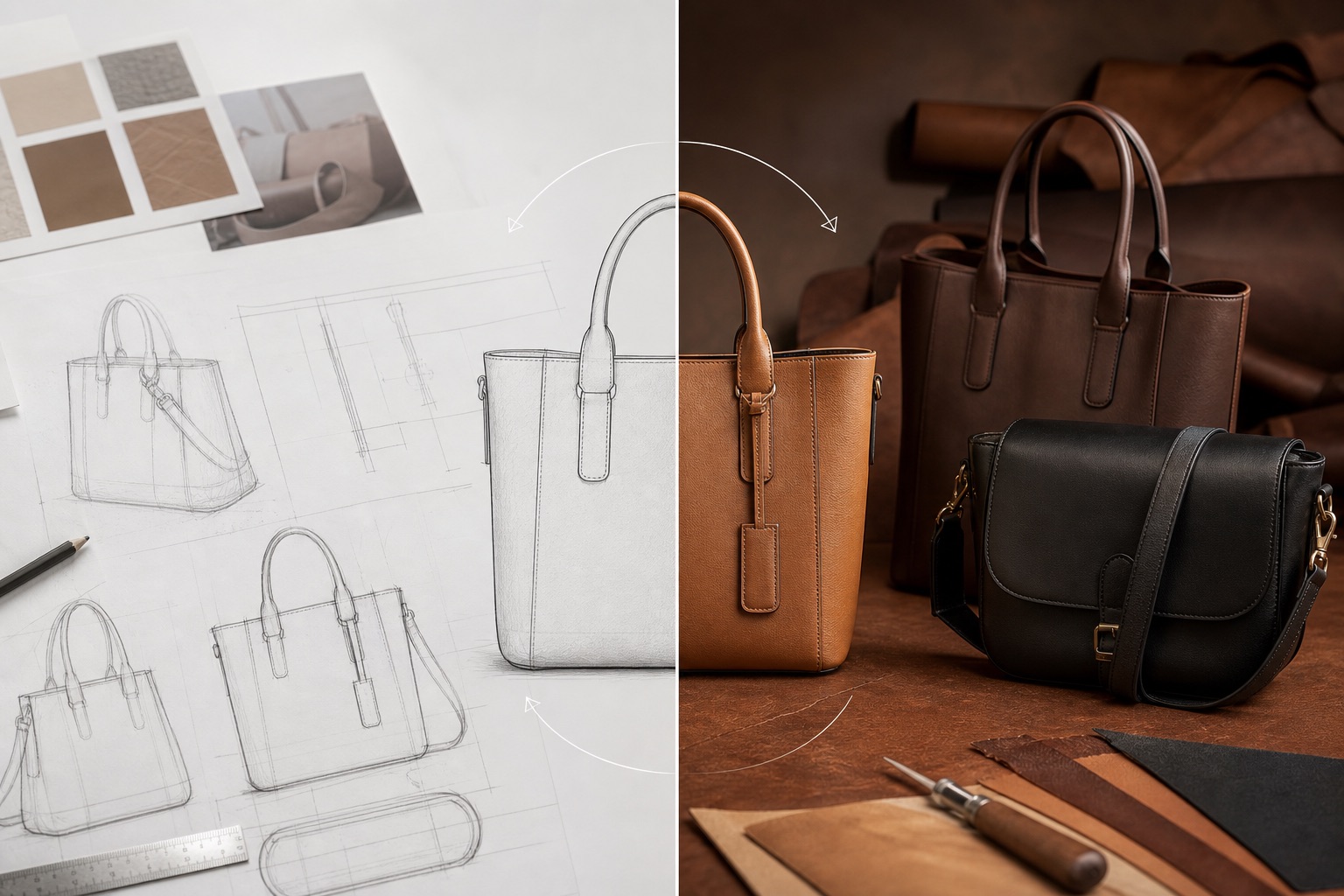
In OEM bag manufacturing, you provide the design—tech pack, dimensions, materials, branding artwork—and the factory manufactures to your specification. The factory acts as a production partner, not a product developer. Your brand owns the design (subject to contract terms), and the bag is produced exclusively for you or as you direct.
OEM is the standard model for established brands with in-house design teams, licensed IP, or specific performance requirements that off-the-shelf products cannot meet.
ODM (Original Design Manufacturer)
In ODM bag manufacturing, the factory provides the design from its catalog or develops a new style that you select and customize (logo, color, minor trim changes). You are essentially private-labeling an existing or semi-custom product. The factory may sell the same base design to other buyers with different branding.
ODM suits buyers who need speed to market, lower development cost, or lack internal design resources—and are comfortable with less product differentiation at the structural level.
Side-by-Side Comparison for Bag Buyers
| Factor | OEM | ODM |
|---|---|---|
| Design ownership | Buyer owns design (with NDA/contract) | Factory owns base design; buyer owns branding |
| Development time | 8–16 weeks (sample iterations) | 2–6 weeks (catalog selection + logo) |
| Development cost | Higher (sampling, tooling, engineering) | Lower (often free catalog samples) |
| MOQ | Higher for fully custom specs | Lower—factory already produces base style |
| Product differentiation | High—unique construction and features | Moderate—limited to trim, color, branding |
| IP / exclusivity risk | Low if contracts are solid | Higher—same design sold to other brands |
| Best for | Brand builders, unique product lines | Fast launch, promotional, budget lines |
When to Choose OEM Bag Manufacturing
OEM is the right path when product uniqueness drives your value proposition. Consider OEM if:
- You have proprietary designs, patents, or trade dress to protect
- Performance specs (waterproof rating, load capacity, laptop fit) are non-negotiable
- Your retail or corporate clients require exclusive products not available elsewhere
- You plan multi-season iterations on a core platform design
- Brand positioning depends on distinctive construction, not just logo placement
OEM requires investment upfront: detailed tech packs, multiple sample rounds, and clear communication with factory pattern makers. The payoff is a product that competitors cannot easily copy by visiting the same factory catalog.
OEM Best Practices
Sign an NDA and manufacturing agreement before sharing designs. Clarify mold, plate, and cutting die ownership—these should belong to you if you paid for them. Specify exclusivity terms if you do not want the factory offering your custom design to others. Conduct pre-production sample sign-off before bulk cutting begins.
When to Choose ODM Bag Manufacturing
ODM accelerates launch when speed and cost matter more than structural uniqueness. Consider ODM if:
- You are testing a new market segment with limited budget
- You need promotional or event bags on a tight deadline
- Your customers value branding and price over unique features
- You are building a broad catalog quickly (many SKUs, low depth per SKU)
- You lack in-house design or technical development capacity
ODM does not mean low quality. Many export factories maintain ODM catalogs with products meeting international test standards. The trade-off is differentiation: your competitor may offer a nearly identical bag with a different logo from the same factory.
ODM Best Practices
Request physical samples from the catalog—not photos alone. Confirm which customization options are included (logo method, hang tag, interior label) and which incur extra fees. Ask explicitly whether the design is exclusive to your brand or shared. If exclusivity matters, negotiate a territorial or time-limited exclusive agreement, often in exchange for volume commitment.
Hybrid Approach: ODM Base + OEM Modifications
Many successful B2B bag lines use a hybrid model. Start from an ODM base style—a proven backpack shell, tote silhouette, or cooler bag body—and request OEM-level modifications: alternate lining, upgraded hardware, unique pocket layout, or custom fabric. This reduces development time versus full OEM from scratch while achieving meaningful differentiation.
Factories familiar with both models can advise which modifications are feasible without new molds or pattern development. A skilled sourcing partner treats ODM as a starting point, not a ceiling.
IP Protection and Contract Essentials
Whether OEM or ODM, protect your interests in writing:
- NDA: Signed before exchanging designs or market plans
- Exclusivity clause: Define territory, duration, and volume triggers
- Tooling ownership: Specify who owns molds, dies, and plates after order completion
- Non-compete: Prevent factory from selling your OEM design to direct competitors
- Quality standards: Attach AQL levels and test requirements to the contract
Making the Decision for Your Business
Neither OEM nor ODM is universally better—they serve different stages and strategies. New brands often launch ODM to validate demand, then transition hero SKUs to OEM as volume and margin justify custom development. Established brands with design capability typically default to OEM but may use ODM for filler SKUs or rush promotional orders.
Ask yourself: Is my competitive advantage the bag itself or the brand around it? If the product must be unique, invest in OEM. If the brand, channel, or service drives sales, ODM may deliver faster ROI. The best sourcing programs use both models deliberately—not by accident.